
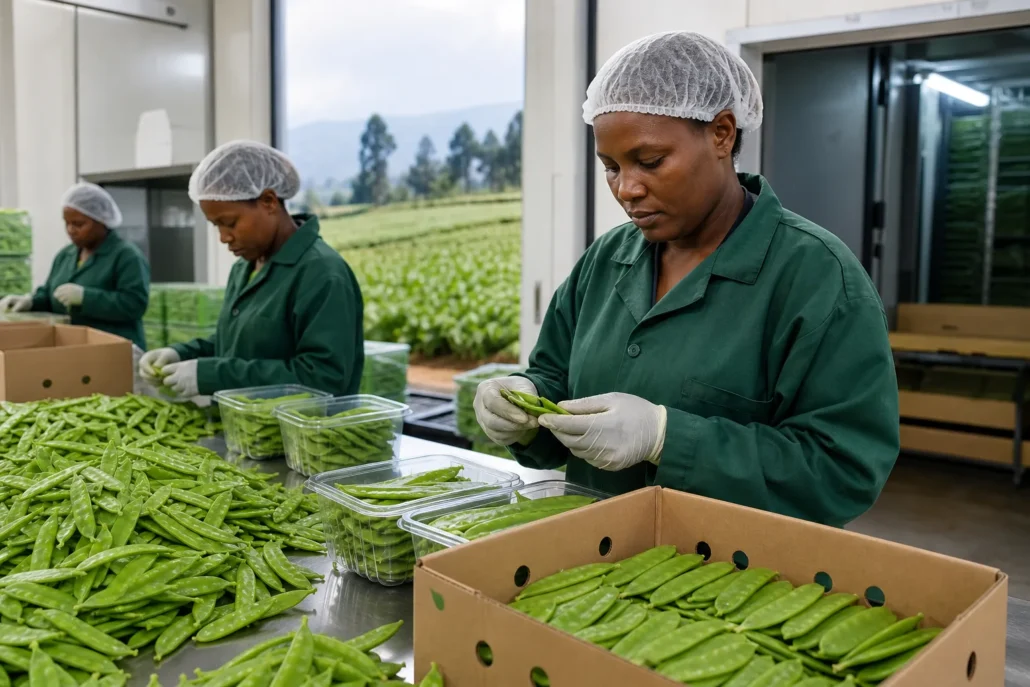
A Kenyan snow peas export quote should price a defined mangetout product, pack programme, delivery window and approval standard. Snow peas are highly perishable and buyer specifications differ, so a vague request for “snow peas to Europe” is not enough for a dependable commercial offer.
This guide helps importers, produce distributors, retailers and food-service buyers prepare an RFQ for seasonal Kenyan snow pea or mangetout supply. It does not promise every variety, pack, volume or route. Afrisun Orchards checks snow and mangetout pea supply against current availability, destination and the buyer’s written requirements.
Buyer takeaway: state whether you need flat edible-pod mangetout or another pea type, then define pod quality, packing, programme volume, destination, delivery window, residue and document requirements, inspection method and requested trade term.
What to include in a Kenyan snow pea export RFQ
| RFQ field | Buyer input | Decision it supports |
|---|---|---|
| Commercial type | Mangetout/snow pea, sugar snap or another clearly defined pea | Prevents a quote for the wrong pod type. |
| Pod specification | Dimensions, colour, tenderness, seed development, trim and defect tolerances | Creates measurable lot acceptance. |
| Pack format | Loose, lined, punnet or other buyer-approved format; net weight and carton configuration | Aligns product protection, freight and destination handling. |
| Programme | Trial volume, quantity per dispatch, frequency and delivery period | Tests whether seasonal supply can match the programme. |
| Destination | Country, entry point, receiver and required handover point | Determines route and compliance questions. |
| Evidence | Traceability, residue plan, audit evidence, inspection and plant-health documents | Defines what must be approved before dispatch. |
| Commercial terms | Currency, requested Incoterm, quotation validity and payment proposal | Makes offers commercially comparable. |
1. Distinguish mangetout from other pea types
“Snow peas” and “mangetout” commonly describe peas eaten with a flat pod. Sugar snap peas are also eaten with the pod but have a different commercial appearance and eating quality. The current UNECE FFV-27 standard for peas distinguishes shelling peas from mange-tout and sugar snap peas intended for consumption with the pod.
State the commercial type in the first line of the RFQ. If a named variety matters, include it, but do not use variety alone as the quality specification. The offer still needs measurable pod and packing criteria.
2. Write a measurable pod-quality specification
For mangetout, a buyer brief can cover:
- pod length and width range;
- flatness and permitted seed development;
- colour, freshness, turgidity and tenderness;
- stalk and blossom-end presentation;
- limits for stringiness, hard film, deformation, scarring or breakage;
- limits for decay, pest damage, foreign matter and abnormal moisture; and
- sampling, tolerance and lot-release method.
UNECE FFV-27 provides a recognised reference for minimum and class-related commercial quality, including requirements relating to soundness, cleanliness, pests and hard filaments or films in edible-pod peas. The buyer and supplier should identify the exact class or customer standard being used; mentioning the document without agreeing tolerances is not enough.
3. Define pack format before requesting price
Snow peas can be supplied for wholesale handling, destination repacking or consumer-ready sale, subject to the actual offer. Tell the supplier which outcome is required. Include net weight, units per carton, food-contact packaging requirements, ventilation, liner or absorbent requirements, closure, carton dimensions, labels and pallet instructions.
If punnets are required, give the unit weight, punnet type, film or lid requirement, number per carton and label artwork workflow. If the buyer expects loose-packed product, state the liner and presentation standard. Do not assume a default pack size or that every packaging material is available for every order window.
4. Request current seasonal availability and a realistic programme
Afrisun’s Products page presents snow and mangetout peas as selected seasonal supply. An RFQ should therefore include the required delivery period and ask what can be supported now. Useful programme fields include:
- trial-order volume;
- volume per dispatch;
- dispatch or delivery frequency;
- earliest acceptable start date;
- programme length;
- receiving-day restrictions; and
- any tolerance for revised quantities or dates.
A quotation should state its validity and the assumptions behind the offer. Fresh-produce timing can depend on crop readiness, packing capacity, official inspection and freight availability. A target plan is not a guarantee until the specific order is confirmed.
5. Align residue, traceability and destination requirements
The buyer should identify the destination’s current residue rules and any stricter customer list. For EU supply, the European Commission provides searchable pesticide and maximum residue level information. Because values and approvals can change, use the current database and the correct commodity classification when building the programme.
The RFQ should also request the traceability fields needed to connect packed product to the relevant production and handling records. If laboratory evidence is required, agree the sample, method, laboratory, analyte scope, reporting limit and point at which the result must be available.
Plant-health and import processes vary by destination. The European Commission explains the general framework for plant products entering the EU from non-EU countries, while Great Britain publishes separate guidance for fruit and vegetable exports from Africa. The licensed importer should confirm the live destination pathway for the specific commodity and route.
6. Verify certificate scope instead of relying on logos
Afrisun publishes current documents on its certificates page. For a snow pea programme, the buyer should review validity dates, named sites, product scope and any conditions, then confirm which evidence applies to the offered lot. This is especially important when supply is seasonal or sourced through more than one production arrangement.
The RFQ should distinguish regulatory documents, customer audits and voluntary certification. They serve different purposes and should not be treated as interchangeable.
7. Agree packing-line, pre-dispatch and arrival checks
Define the approval record before packing begins. Depending on the contract, it may include a signed product specification, packaging approval, label proof, lot-coded photographs, inspection results, traceability summary, residue evidence and document checklist.
Also define the arrival check and claims process. The receiver can record carton condition, quantity, lot identity, product condition, temperature where contractually relevant and a representative defect assessment. Agree notification time, evidence and who may inspect a disputed lot. These details protect both buyer and supplier.
8. State delivery point, route and commercial handover
Edible-pod peas need careful time and temperature planning, but a single route or setting should not be presented as correct for every market. Give the supplier the destination, receiving schedule and required condition on arrival. Ask the offer to identify the proposed route, named handover point, responsibilities and documents.
If using an Incoterm, include the named place and contract version. Afrisun’s role is published as coordination across sourcing, quality, packing, documentation and shipment timing. Unless a written offer states otherwise, do not assume Afrisun is the airline, freight forwarder, customs broker or destination importer.
Copyable Kenyan snow peas RFQ checklist
- Buyer: company, contact and intended sales channel
- Destination: country, entry point and delivery location
- Product: mangetout/snow pea or other pea type
- Pod specification: dimensions, appearance, seed development and defect tolerances
- Pack: loose or punnet format, net weight, carton, label and pallet details
- Programme: trial volume, dispatch quantity, frequency and delivery period
- Evidence: traceability, residue, audit, plant-health and inspection requirements
- Commercial request: currency, Incoterm and named place
- Approval: specification, packaging, documents, release and arrival-claims process
How Afrisun handles a snow pea enquiry
Afrisun’s buyer-support approach begins with the brief, then checks suitable supply and evidence before quality approval and export coordination. A complete RFQ helps the team decide whether the requested pod specification, pack, programme and destination can be supported during the relevant season.
Request a current Kenyan snow peas export quote and include your destination, delivery period, volume and frequency, pack format and buyer specification.
Frequently asked questions
Are snow peas and mangetout the same?
They are commonly used for the same flat edible-pod pea. The RFQ should still distinguish them from sugar snap and shelling peas and state measurable pod requirements.
Can I request consumer-ready punnets?
Include the unit weight, punnet, closure, label and carton specification in the enquiry. Availability and pricing must be confirmed for the specific programme.
Is seasonal supply available every week?
No continuous volume should be assumed. Ask for a current availability check and a written programme covering quantity, frequency and delivery windows.
Which documents are needed for import?
The requirements depend on the commodity, destination and route. The licensed importer should confirm the current pathway, and the quote should allocate responsibility for each document.
How do I compare two snow pea export quotes?
Compare offers against the same pod specification, pack configuration, volume, delivery point, trade term, evidence and approval process. A lower unit price may not be comparable if those inputs differ.
Also buying beans? Use the companion Kenyan French beans export RFQ guide.