
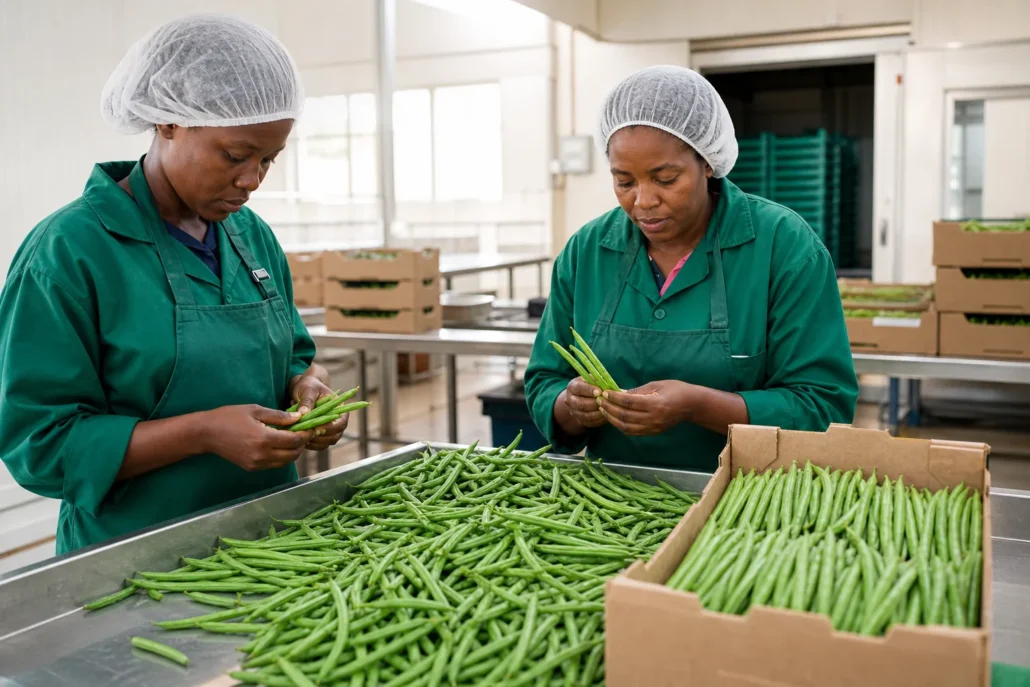
A Kenyan French beans export quote is useful only when the buyer and supplier are pricing the same product, pack format, delivery point and approval standard. A request that says only “send your best price for green beans” leaves the most important commercial questions unanswered.
This guide helps importers, wholesalers, retailers and food-service distributors prepare a clear request for quotation (RFQ) for seasonal Kenyan fine or French bean supply. It does not promise that every specification, volume or shipping window is currently available. Afrisun Orchards assesses fine-bean supply against the buyer brief, season, destination and available evidence.
Buyer takeaway: define the product, measurable quality criteria, packing, volume and frequency, delivery window, destination, trade term and required evidence before asking for price. That makes offers easier to compare and reduces avoidable changes after harvest or packing.
What a useful French bean export quote should answer
The quote should connect the commercial offer to a written specification. The following fields form a practical starting point.
| RFQ field | What the buyer should state | Why it matters |
|---|---|---|
| Product | French beans, fine beans or another agreed commercial type | Names can be used differently across markets. |
| Destination and channel | Country, airport or delivery point, and retail, wholesale, repacking or food-service use | Requirements and pack presentation depend on the destination and customer. |
| Quality specification | Pod dimensions, appearance, freshness, permitted defects and inspection method | “Premium” is not a measurable acceptance criterion. |
| Packing | Net weight, units per carton, liner or punnet needs, label data and pallet instructions | Packing affects handling, freight use and shelf presentation. |
| Programme | Required quantity, order frequency, first delivery window and programme duration | A one-off trial and a recurring programme need different planning. |
| Approval evidence | Photos, inspection record, residue plan, traceability data or other agreed evidence | The parties need the same release point before dispatch. |
| Commercial basis | Currency, requested Incoterm, quotation validity and payment proposal | A product price without a handover point is incomplete. |
1. Identify the exact product and sales channel
Start by naming the product as your market buys it. “French beans,” “fine beans,” “extra-fine beans” and “green beans” may describe overlapping but not always identical commercial expectations. If a variety or commercial type matters, include it. If it does not, describe the physical result the buyer needs instead of assuming that a trade name is understood in the same way.
The end channel also changes the brief. A wholesale carton intended for a destination repacker is different from a consumer-ready punnet programme. Tell the supplier whether the beans are for retail shelves, food service, wholesale resale or repacking, and state any customer manual that must be followed.
2. Convert “good quality” into measurable acceptance criteria
A buyer specification should describe what will be inspected and how a lot will pass. Depending on the programme, that can include:
- required pod length and diameter range;
- colour, straightness, tenderness and freshness;
- stalk-end presentation and trimming instructions;
- limits for breakage, scarring, deformation, pest damage, decay or foreign matter;
- sampling method, sample size and tolerance calculation; and
- the inspection point that controls release: packing, pre-dispatch or arrival.
The UNECE FFV-06 standard for beans is a useful technical reference for commercial quality discussions. It covers minimum qualities such as soundness, cleanliness, fresh appearance and suitability for transport. A buyer contract may require different or additional criteria, so the applicable class, tolerances and customer rules should be written into the RFQ rather than assumed.
3. Specify the pack, label and pallet outcome
Ask for a price against one defined pack configuration. Include the net product weight, number of packs per carton, carton dimensions or performance requirements, ventilation needs, liner or absorbent requirements, closure method and pallet pattern. If the buyer supplies artwork or labels, state who approves them and when final print files must be available.
Label requirements can include product name, origin, lot code, packer information, net weight, customer code and date information. The exact list depends on the destination, customer and pack type. The supplier should not have to infer a legal or retail label from an informal email.
4. Match volume and delivery timing to current availability
Afrisun lists fine beans as selected seasonal fresh produce. Buyers should therefore request a current availability check instead of assuming continuous supply. State:
- trial-order quantity, if applicable;
- required quantity per dispatch;
- weekly or monthly frequency;
- earliest acceptable first dispatch;
- delivery-day or receiving-window constraints; and
- whether partial fulfilment or a revised window can be considered.
Volume and timing should be confirmed in a written offer. Weather, crop stage, packhouse scheduling, inspection and freight capacity can affect a fresh-produce programme; none should be treated as guaranteed until the parties agree the specific order.
5. Define traceability, residue and plant-health evidence
The destination and customer determine the evidence needed for a consignment. The RFQ should identify applicable pesticide-residue requirements, the laboratory or report format requested by the buyer, traceability fields, plant-health documents and any customer audit evidence.
For EU programmes, buyers can use the European Commission’s current pesticide and maximum residue level databases rather than relying on an old spreadsheet. The Commission also explains that specified plant products entering the EU require phytosanitary certification from the exporting country’s plant-protection authority. Other destinations have their own rules.
Afrisun publishes a certificate and audit evidence page. Buyers should check the current validity, product scope, sites and lot relevance of any certificate before relying on it for a programme. A logo alone is not a substitute for reviewing the document that applies to the offered supply.
6. Agree inspection, release and claims evidence
Decide who inspects, where inspection happens and what record will be shared. A practical approval sequence may include the confirmed buyer specification, packing-line checks, lot-coded photographs, an inspection sheet and document review before dispatch. If an independent inspection is required, identify the inspector and booking responsibility in advance.
The order should also define what the buyer records on arrival: delivery temperature where relevant, carton condition, lot identity, quantity, representative product photographs and defect assessment. Clear evidence and notification windows make any genuine claim easier to investigate.
7. State the route, handover point and requested trade term
Fresh beans are time-sensitive, but there is no universal route or transit promise for every destination. Give the supplier the receiving location and required arrival window, then ask which route and dispatch plan can support the requested programme. If the RFQ requests an Incoterm, include the named place and version used in the contract.
Afrisun describes its role as export coordination across sourcing, quality approval, packing, documentation and shipment timing. It should not be assumed to be the carrier, freight forwarder, destination importer or customs broker unless a specific written offer says so.
Copyable Kenyan French beans RFQ checklist
- Buyer: company, contact person and website
- Destination: country, airport or named delivery point
- Product: French/fine bean commercial type and intended channel
- Specification: dimensions, appearance, defect tolerances and inspection method
- Pack: unit, net weight, cartons, labels and pallet requirement
- Programme: trial quantity, dispatch quantity, frequency and delivery window
- Evidence: residue, traceability, audit, plant-health and pre-shipment records required
- Commercial request: currency, Incoterm and named place
- Approval: who signs off specification, labels, documents and dispatch
How Afrisun handles a fine-bean enquiry
Afrisun’s published buyer-support process is to understand the brief, match available supply, agree quality requirements and coordinate the export stages. For fine beans, the first useful step is a complete RFQ and a request for current seasonal availability. The response should then identify what can be offered, what evidence is available and which points still require buyer confirmation.
Request a current Kenyan French beans export quote and include your destination, volume and order frequency, delivery period, packaging and additional specification requirements.
Frequently asked questions
Are fine beans and French beans the same product?
The names often overlap, but commercial use varies. A buyer should specify the required type and measurable pod criteria instead of relying on the name alone.
Can Afrisun provide a fixed price without a buyer specification?
A comparable quote needs a product specification, pack, volume, timing, destination and handover point. Current availability and commercial terms must be confirmed for the actual enquiry.
Does a certificate automatically cover every offered lot?
No. Buyers should verify the current certificate, its product and site scope, validity dates and relevance to the offered lot or programme.
Which export documents will be supplied?
The document set depends on the product, route, destination and contract. State the required documents in the RFQ and confirm responsibility for each before dispatch.
What should I send to get a useful quote?
Send the buyer checklist above through the Afrisun buyer-enquiry form. The stronger the brief, the faster both parties can identify whether a workable seasonal offer is available.
Also sourcing edible-pod peas? Use the companion Kenyan snow peas and mangetout export RFQ guide.