
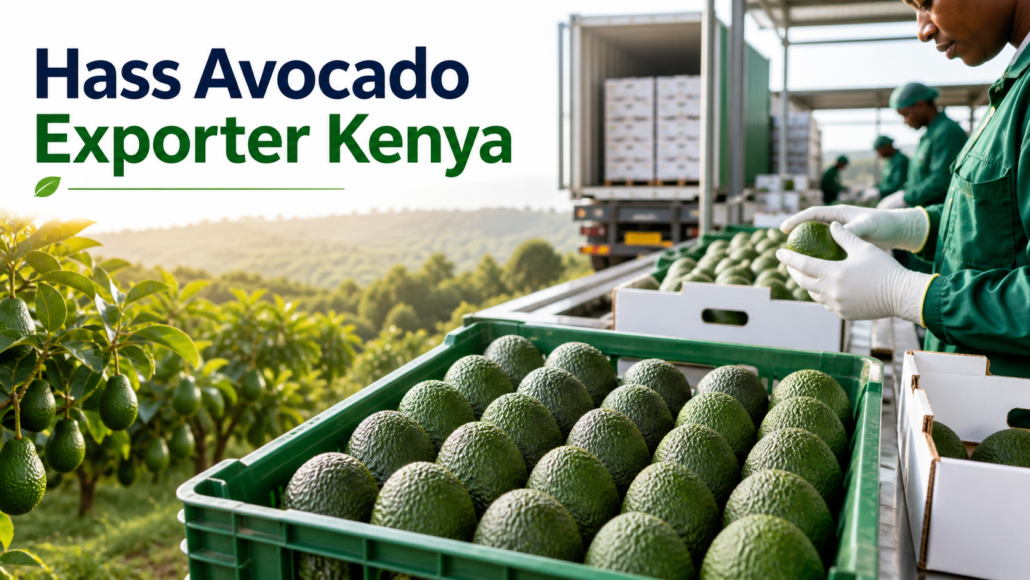
For a wholesale avocado buyer, “Hass avocados from Kenya” is only the beginning of a usable order specification. The exporter also needs the required count sizes, carton net weight, acceptable size tolerance, label details, pallet configuration, delivery market and transport plan.
This guide explains how importers, wholesalers, retailers and food-service distributors can prepare a clear Kenyan avocado packaging specification before a quotation or shipment is confirmed.
What avocado size means in wholesale trading
Export avocados are commonly ordered by count: the number of individual fruits packed in a carton. A lower count generally indicates larger fruit, while a higher count generally indicates smaller fruit. However, a count number is meaningful only when it is paired with the agreed carton net weight and packing standard.
For example, asking for “count 18” without stating the carton format can create ambiguity. Buyers should specify the required count, carton net weight, acceptable adjacent counts and tolerance for the overall consignment.
The size distribution available from an orchard lot can vary by variety, growing area, maturity and week of harvest. Afrisun Orchards therefore confirms sizes against current availability rather than treating every count as continuously available.
Information to include in an avocado size specification
- Variety, such as Hass, Fuerte or Pinkerton
- Required count sizes and acceptable adjacent counts
- Carton net weight
- Permitted weight or count tolerance
- Required grade and defect limits
- Maturity or dry-matter requirement
- Expected ripening condition at arrival
- Weekly volume and delivery period
Size should not be assessed in isolation. Fruit of the correct count can still be unsuitable if maturity, shape, skin condition, mechanical damage or shelf-life expectations do not match the buyer’s programme.
Choosing an avocado export carton
The carton protects the fruit through packing, cooling, handling, transport and distribution. The correct format depends on the route, destination, customer channel and buyer specification.
A commercial packing discussion should cover:
- Net weight: the agreed weight of fruit, excluding packaging.
- Carton strength: suitable for stacking, pallet handling and the expected transport conditions.
- Ventilation: openings that support airflow without weakening the carton or exposing fruit to avoidable damage.
- Fruit arrangement: a pack pattern that limits movement, compression and abrasion.
- Materials: liners, trays or other components where required by the programme.
- Branding: plain, exporter-branded or customer-approved artwork.
- Destination rules: applicable language, recycling, food-contact, labelling and import requirements.
No single carton is automatically suitable for every market. A format used for a short air-freight movement may not be the best choice for a longer sea-freight programme.
Labels and traceability
Carton labels should allow the shipment to be identified and traced. The exact fields depend on the transaction and destination, but a buyer may request details such as:
- Product and variety
- Country of origin
- Count or size
- Net weight
- Exporter or packer identification
- Lot or traceability code
- Packing date
- Customer reference, barcode or purchase-order number
- Storage or handling information where required
The final label should be approved before production. This helps avoid delays caused by missing customer references, incorrect wording or destination-specific requirements.
Palletisation and shipment planning
Packaging decisions affect the full logistics plan. Before packing begins, the buyer and exporter should agree the number of cartons per pallet, pallet type, stacking pattern, corner protection, strapping or wrapping, and any height or weight limits imposed by the carrier or receiver.
The plan should also connect the harvest date, packing date, cooling process, loading date, expected transit time and target arrival condition. Packaging cannot compensate for fruit harvested at the wrong maturity or a break in temperature management.
Quality checks before cartons are closed
A packing specification should be supported by a quality-control process. Depending on the agreed programme, checks may include:
- Variety and lot identity
- Maturity result
- Count and size distribution
- Net carton weight
- External defects and mechanical damage
- Carton condition and ventilation
- Label accuracy
- Pallet configuration
- Photographic or inspection records
Buyers should agree the sampling method, acceptance limits and claims procedure before shipment. A written approval process is more reliable than resolving different expectations after the fruit arrives.
A practical avocado packaging brief
When requesting a quotation from Afrisun Orchards, provide:
- Destination country and port or airport
- Required variety
- Preferred count sizes and acceptable alternatives
- Carton net weight and style
- Label and branding requirements
- Pallet specification
- Trial, weekly or total volume
- Requested shipment window
- Air or sea freight preference
- Required quality, traceability and compliance documents
This information allows the proposed pack to be checked against crop availability, packhouse capability, transport conditions and destination requirements.
How this fits into a Kenyan avocado order
Packaging should be confirmed after the buyer defines the product and destination but before cartons, labels and freight are booked. Buyers planning a programme can review our Kenyan avocado importer checklist and Kenya avocado export season guide.
For current product and packing discussions, visit our Kenyan avocado export supply page.
Frequently asked questions
Can buyers request specific avocado counts?
Yes. Buyers can state preferred counts and acceptable alternatives. Confirmation remains subject to the actual size distribution available for the proposed packing period.
Does a count number mean the same thing for every carton?
No. The count should be read together with the carton net weight and agreed standard. State both in the purchase specification.
Can Afrisun provide buyer-branded cartons?
Branding and label requirements can be discussed for each programme. Feasibility, quantities, lead times and artwork approval must be confirmed before packing.
Which packaging is best for sea freight?
The choice depends on fruit maturity, transit time, ventilation, stacking strength, cooling plan and destination requirements. It should be agreed as part of the complete shipment specification.
Request a packaging and size check
Send Afrisun Orchards your destination, variety, required counts, carton net weight, label specification, forecast volume and delivery window. We will use the brief to assess current availability and the appropriate packing plan.
This article is a commercial planning guide. Importers should verify current plant-health, food-safety, labelling and customs requirements with the competent authorities for the destination market before shipment.
Need export-ready Kenyan avocados?
Share your variety, size count, volume, packaging, destination and delivery window. Afrisun Orchards will help coordinate verified sourcing, quality control and export preparation.